Vibe Coding vs Agentic Coding: When to Use Which
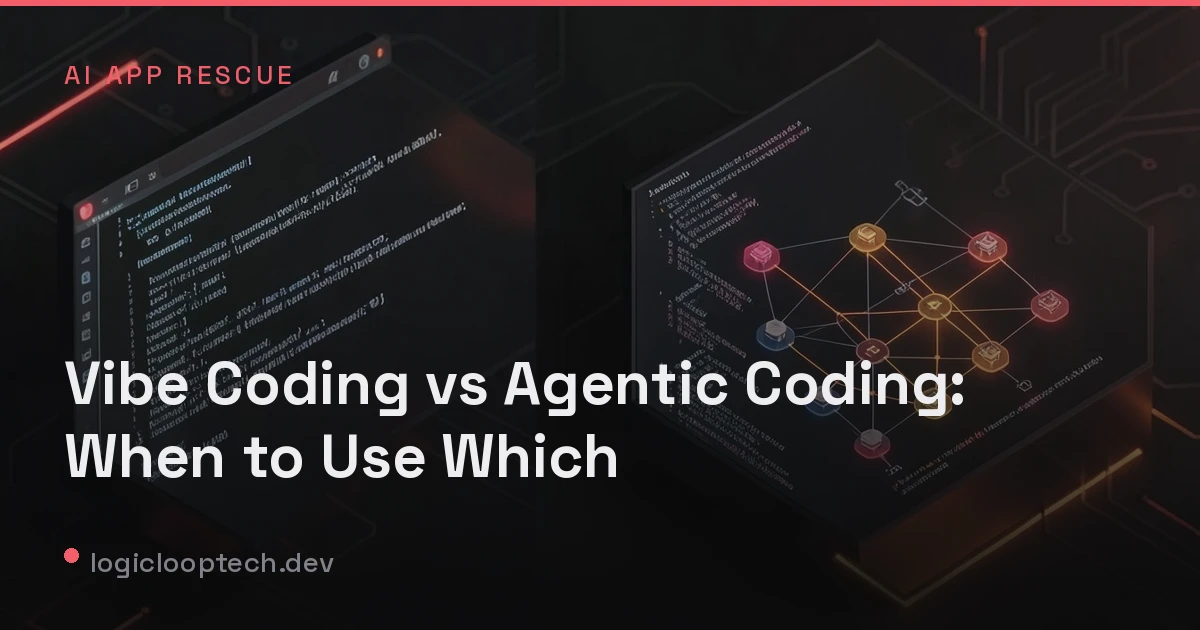
You hit a wall because you used vibe coding for a job that needed an agent. Vibe coding is context-aware generation inside your editor. Agentic coding is an intent-driven loop that plans, acts, and verifies against a goal. Use vibe coding for scaffolding and exploration. Switch to agents for complex refactors, multi-file features, and anything that must pass CI before it merges.
What is the core difference between vibe coding and agentic coding
Vibe coding keeps you in the loop. You prompt, the model completes, you accept or tweak. It is reactive. The model sees your open files and recent edits. It predicts the next chunk. Cursor Tab and GitHub Copilot work this way.
Agentic coding hands the wheel to a loop. You describe an outcome. The agent writes a plan, spins up a terminal, runs tests, reads errors, and iterates until the suite passes. Claude Code, OpenAI Agents SDK, and Cursor Composer in agent mode work this way. They maintain a scratchpad of state across steps.
I learned this distinction the hard way. Last quarter I asked a vibe tool to “add idempotency keys to the payment webhook.” It generated a decorator. It looked correct. It missed the unique constraint on the database column. The migration ran. The column allowed duplicates. We shipped a bug that cost us a weekend rollback. An agent would have written the migration, run it against a test DB, executed the integration suite, and caught the missing constraint before I reviewed the diff.
Decision matrix: project scope, codebase maturity, and team expertise
| Factor | Vibe Coding | Agentic Coding |
|---|---|---|
| Scope | Single file, greenfield, boilerplate | Multi-file, cross-layer, refactors |
| Maturity | New repo, low test coverage | Established repo, CI gate, type checks |
| Team | Solo founder, fast iteration | Two plus engineers, review required |
| Risk tolerance | Throwaway spikes, internal tools | Payments, auth, data pipelines |
If you are building a FastAPI endpoint that wraps a third-party API, vibe coding gets you there in minutes. If you are rewriting the authentication middleware to support device binding across three services, you need an agent. The agent can search the codebase for every usage of the old middleware, propose a migration plan, and run the contract tests after each change.
Toolchain comparison: Cursor Composer vs Claude Code vs OpenAI Agents SDK
Cursor Composer sits in your IDE. It reads the open tabs. In normal mode it is pure vibe coding. Flip the agent toggle and it becomes a lightweight agent. It can run pytest and apply patches. It struggles when the task spans more than five files or requires shell commands outside the repo root.
Claude Code runs in your terminal. It has full shell access. It reads your pyproject.toml, sees your Makefile, and knows how to spin up Docker Compose. I use it for database migrations and schema-driven code generation. It is slower per step but catches environment drift that IDE tools miss.
OpenAI Agents SDK is for building your own agents. You define tools, handoffs, and guardrails in Python. It is overkill for daily coding. It shines when you need a repeatable pipeline. For example, a nightly job that reads Jira tickets, writes implementation plans, opens PRs, and posts summaries to Slack. That is not a coding assistant. That is a robot engineer.
Hybrid workflow: using vibe coding for scaffolding and agents for complex refactors
My daily loop looks like this:
- Open a fresh branch.
- Use Cursor Tab to scaffold the route, the Pydantic models, and the service stub. Ten minutes.
- Write one failing integration test that describes the happy path.
- Switch to Cursor Composer agent mode. Prompt: “Make the test pass. Do not change the test. Run
pytest tests/integration/test_payments.py -xvsafter each edit.” - Review the diff. Commit. Push. Open PR.
Step two is vibe coding. Step four is agentic. The boundary is the test. Once a test exists, the agent has a verifiable goal. Without a test, the agent hallucinates requirements.
Here is a minimal FastAPI scaffold I generate with vibe coding before handing off to an agent:
from fastapi import APIRouter, Depends, HTTPException, statusfrom pydantic import BaseModel, Fieldfrom uuid import UUID
router = APIRouter(prefix="/payments", tags=["payments"])
class PaymentRequest(BaseModel):    amount_cents: int = Field(gt=0)    currency: str = Field(pattern="^[A-Z]{3}$")    idempotency_key: UUID
class PaymentResponse(BaseModel):    payment_id: UUID    status: str
@router.post("", response_model=PaymentResponse, status_code=status.HTTP_201_CREATED)async def create_payment(payload: PaymentRequest) -> PaymentResponse:    # TODO: implement idempotency check, charge, persist    raise NotImplementedError
The agent then implements the service layer, adds the unique index migration, and wires the dependency injection. I never ask an agent to “write a payment endpoint.” I ask it to “make this specific test pass.”
Risk management: testing strategies and rollback procedures for each approach
Vibe coding produces code you have not seen run. Treat every suggestion as unreviewed PR. Run the linter. Run the type checker. Run the specific test file you care about. Do not trust the green checkmark in the IDE gutter.
Agentic coding produces code that passed a test suite you defined. The risk shifts to the test suite quality. If your tests mock the database, the agent will write code that works with mocks and fails in staging. I require at least one integration test per agent task that hits a real Postgres instance in a test container.
Rollback is simpler with agents. The agent works on a branch. Every step is a commit. git reset --hard HEAD~3 undoes the whole experiment. Vibe coding often leaves half-applied edits across five files with no commit history. You waste time untangling the mess.
For database changes, I pair agents with a migration checklist. The agent writes the Alembic revision. I review the upgrade and downgrade SQL. We run it against a copy of production data in staging. Only then does it merge. This pattern saved us when an agent tried to add a non-nullable column without a default on a ten million row table. The migration would have locked the table for hours. I caught it in review because the checklist forced me to read the SQL.
Production readiness checklist: observability, evals, and CI/CD integration
Before any AI-generated code reaches production, it clears this list:
- Type hints pass
mypy --stricton changed files - Unit tests cover new logic with
pytest -k "unit" - Integration tests hit real dependencies with
pytest -k "integration" - Structured logs emit
request_id,user_id,latency_ms - Metrics increment
payments.created,payments.failed,payments.idempotent_replay - OpenAPI spec updates automatically via
fastapi.openapi - CI runs the full suite on every push including lint, type, test, and build
Agents can enforce this checklist. Add a pre-commit hook that runs ruff, mypy, and pytest --co -q. Configure the agent to run the hook after each edit. If the hook fails, the agent sees the error and retries. This turns the agent into a CI participant instead of a code generator.
For teams adopting this workflow, I wrote a deeper guide on FastAPI background tasks poll APIs, create PDFs, send email that shows how to structure long-running work so agents can test it reliably. If you are deciding between service boundaries, the Event-Driven Architecture vs Microservices: How to Choose piece maps the trade-offs we faced at scale.
FAQ
Can I use vibe coding for production code? Yes, if you review every line, run the tests yourself, and the change fits in one file. Treat it like a junior PR you must audit line by line.
When should I switch from vibe coding to an agent? When the task touches more than three files, requires shell commands, or needs to pass a test suite you did not write by hand.
Do agents replace code review? No. Agents implement. Humans approve. The agent gives you a cleaner diff with passing tests. You still own the architecture decisions.
How do I stop agents from hallucinating APIs?
Give them a failing integration test that uses the real client library. Constrain the prompt: “Only edit files under app/services/. Do not invent new public methods.”
Key Takeaways
- Vibe coding is reactive completion. Agentic coding is a goal-driven loop that verifies its own work.
- Use vibe coding for scaffolding, exploration, and single-file changes.
- Use agents for multi-file refactors, test-driven implementation, and any change that must pass CI.
- The test is the contract. Write the test first. Let the agent make it pass.
- Always review generated migrations and schema changes by hand. Agents miss operational constraints.
- Wire agents into your CI gates. Let them feel the same pain as human contributors.
Working on something similar?
If you're building backend or AI systems and want a second set of senior eyes, let's talk.